
Solar Technology & Equipment•28 October 2026
TOPCon vs. PERC Solar Panels: Which Cell Technology Is Best for Australian Climates?
Solar technology is evolving rapidly, and TOPCon panels are taking over the Australian residential market. But how do N-Type TOPCon panels differ from traditional P-Type PERC panels, and is the upgrade worth it for your home? Hujurat Solar compares efficiency, heat tolerance, degradation rates, and long-term ROI to help you make an informed decision for Australian weather conditions.
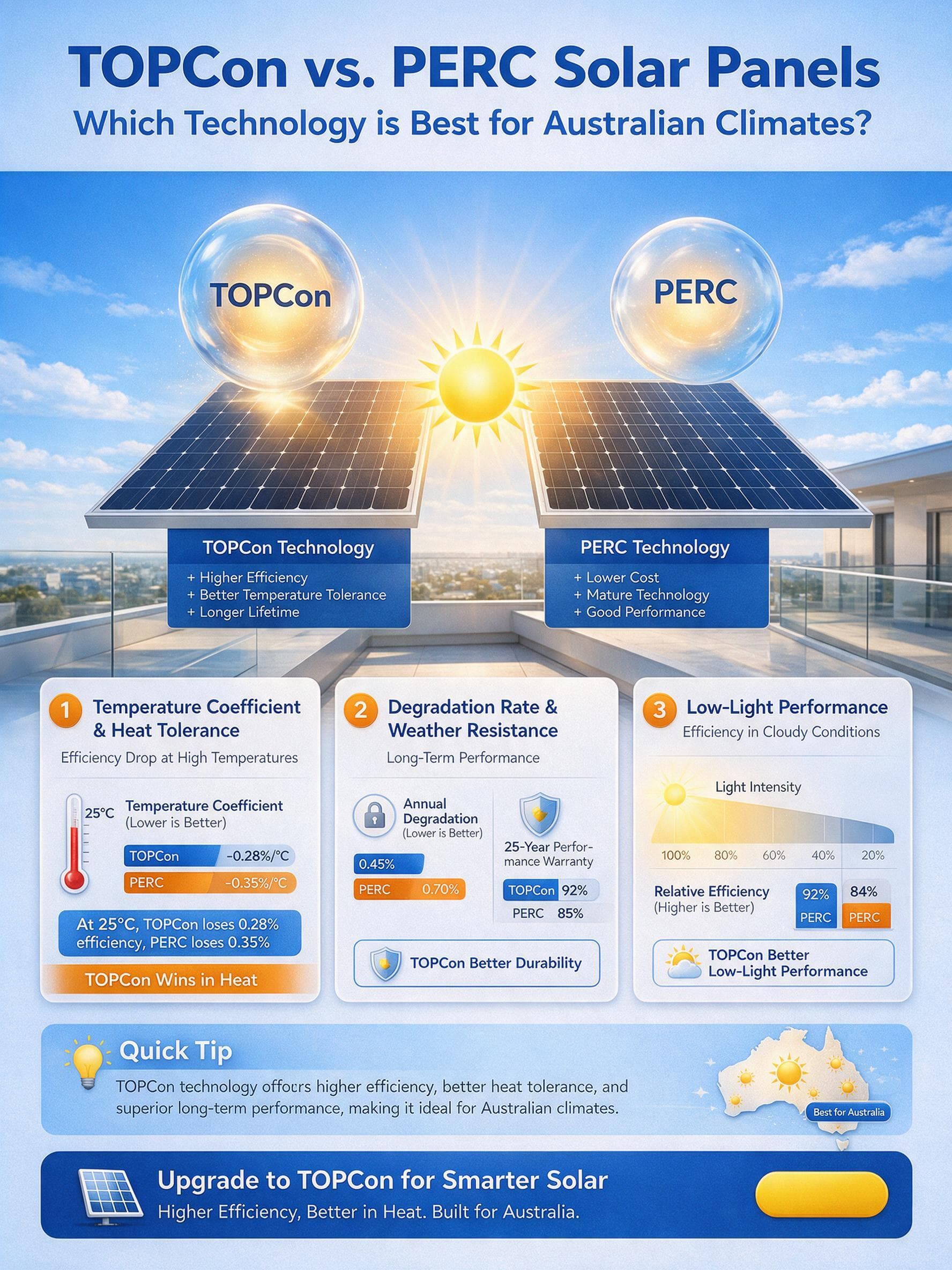
When shopping for rooftop solar panels in Australia, you will frequently encounter technical terms like PERC and TOPCon. While PERC (Passivated Emitter and Rear Cell) has been the industry workhorse for years, N-Type TOPCon (Tunnel Oxide Passivated Contact) has quickly become the new standard for premium installations.
Understanding the difference between these two cell architectures ensures you invest in panels built to handle Australia’s extreme summer heat and deliver maximum power over a 25-to-30-year lifespan.
-
Panel Efficiency Ratings => P-Type PERC: Standard residential PERC modules typically deliver efficiencies between 20% and 21.5%.
=> N-Type TOPCon: TOPCon technology increases cell efficiency up to 22.5% to 23.5%+. Higher efficiency means you get more wattage per square meter, making TOPCon ideal for homes with limited roof space. -
Performance in Hot Weather (Temperature Coefficient) Australia's hot climate causes standard solar panels to temporarily lose power output as temperatures rise above 25°C. => PERC Panels: Feature a average temperature coefficient of -0.35% per °C. => TOPCon Panels: Boast a superior temperature coefficient around -0.30% per °C. This means TOPCon panels lose significantly less output on 35°C+ summer days, generating noticeable extra energy during peak sunshine hours
-
Degradation Rates & Lifespan => LID (Light-Induced Degradation): P-Type PERC panels suffer higher initial degradation in their first year due to boron-oxygen reactions. N-Type TOPCon panels use phosphorus instead of boron, making them virtually immune to LID. => Annual Degradation: TOPCon panels degrade at a lower rate (~0.4% per year) compared to PERC (~0.55% per year), delivering up to 80-85% of their original capacity after 30 years.
Feature P-Type PERC N-Type TOPCon
Max Module Efficiency ~20.5% - 21.5% ~22.0% - 23.5% Heat Performance Standard Superior (Lower power loss) First-Year Degradation 2% - 3% 1% or lower Ideal Roof Type Large, unshaded roofs Limited roof space or hot regions Price Point Budget-friendly Mid to Premium
The Hujurat Solar Verdict While PERC panels remain a reliable, budget-conscious option, N-Type TOPCon solar panels offer superior long-term ROI for Australian homes—especially in warmer regions or homes requiring maximum energy output from smaller roofs.
Ready to install next-generation solar panels? Get in touch with Hujurat Solar for a free system design and tier-1 panel recommendation tailored to your property.
Written by Hujurat Solar Team
Get a free quote