
EV Charging & Smart Energy•6 November 2026
How to Charge Your Electric Vehicle with Solar Power in Australia: Smart EV Integration Guide
Driving an Electric Vehicle (EV) is even more economical when you fuel it directly from your own roof. Charging your EV with excess daytime solar generation reduces your driving costs to virtually zero while relieving stress on the electricity grid. In this guide, Hujurat Solar explains how smart EV chargers work with rooftop solar, how much capacity you need, and how to optimize your charging setup.
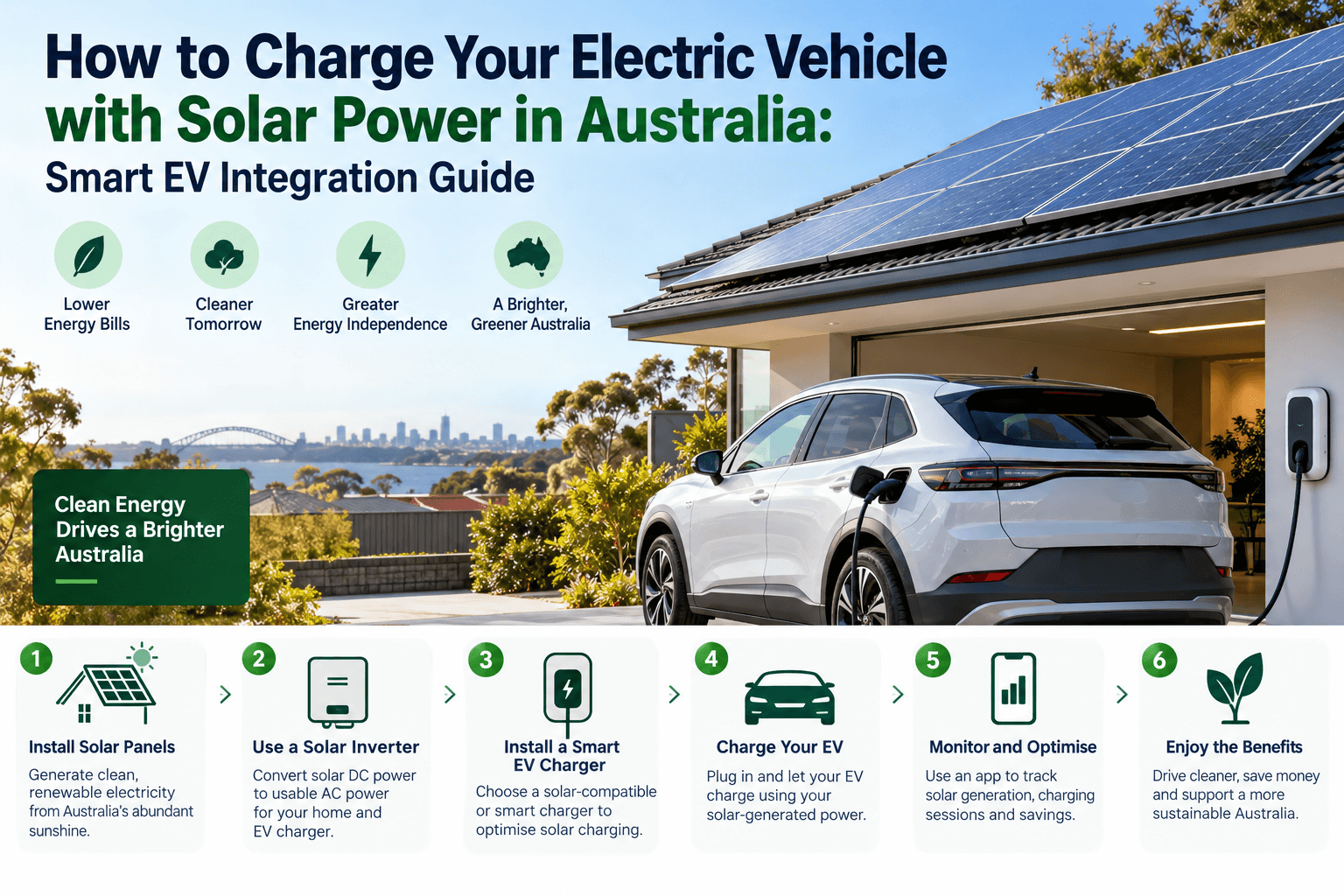
Electric vehicle adoption across Australia is accelerating rapidly. But plugging your EV into standard grid power during peak evening hours can significantly increase your electricity bills. By pairing your EV with a dedicated smart home solar charging setup, you can drive on 100% self-generated clean energy.
Here is everything you need to know about integrating EV charging with your rooftop solar system.
-
Level 1 vs. Level 2 Charging: What’s the Difference?
=>Level 1 (Standard 3-Pin Wall Outlet): Plugs into a regular 10A socket delivering roughly 2.4 kW (~10-15 km of range added per hour). While simple, it charges slowly and cannot automatically adjust to match your solar panel output. =>Level 2 (Dedicated Smart Wall Charger): Professionally wired 7 kW (single-phase) or 22 kW (three-phase) wallbox chargers. Smart Level 2 chargers communicate directly with your solar inverter to direct unused daytime solar directly into your car's battery. -
What Is "Solar Match" or Dynamic Solar Charging? Standard chargers draw a fixed amount of power from whatever source is available—whether solar or grid. Smart solar EV chargers (such as Zappi, Enphase, or Fronius Wattpilot) monitor your real-time household energy usage
=> Eco / Solar-Only Mode: The charger measures how much surplus solar power your roof is producing (e.g., 4.2 kW of excess) and feeds only that amount into your EV. If cloud cover reduces surplus to 2 kW, the charger automatically throttles back so you don't pull power from the grid. => Fast Mode: Charges your vehicle at full capacity using a combination of solar and grid power when you need a fast top-up before a long drive. -
How Big of a Solar System Do You Need for an EV? The average Australian drives approximately 35–40 km per day, requiring around 6 to 8 kWh of energy daily.
=> A standard 6.6 kW solar system produces plenty of energy to cover daily household needs plus an average commute, provided the car is parked at home during daylight hours.
=> If you drive longer distances or charge multiple EVs, upgrading to an 8 kW to 10 kW solar system ensures ample daytime solar surplus.
=> If your car is parked at work during the day, adding a home battery allows you to store daytime solar energy and dump it into your EV overnight.
Maximize Your Fuel Savings with Hujurat Solar Combining rooftop solar with a smart EV charger turns your home into a personal zero-emission service station. At Hujurat Solar, we install integrated solar and smart EV charging solutions designed for Australian homes and electrical standards.
Contact Hujurat Solar today to upgrade your home with a future-proof solar and EV charging solution!
Written by Hujurat Solar Team
Get a free quote