
Solar Technology•26 October 2026
Solar Inverter Guide || String vs Microinverters in Australia: Which Solar Inverter Is Right for Your Home?
Choosing the right solar inverter is an important step when installing rooftop solar in Australia. From traditional string inverters to microinverters and power optimisers, each option offers different benefits depending on your roof layout, shading conditions and energy needs. Discover how these technologies work and how to choose a suitable inverter for your home.
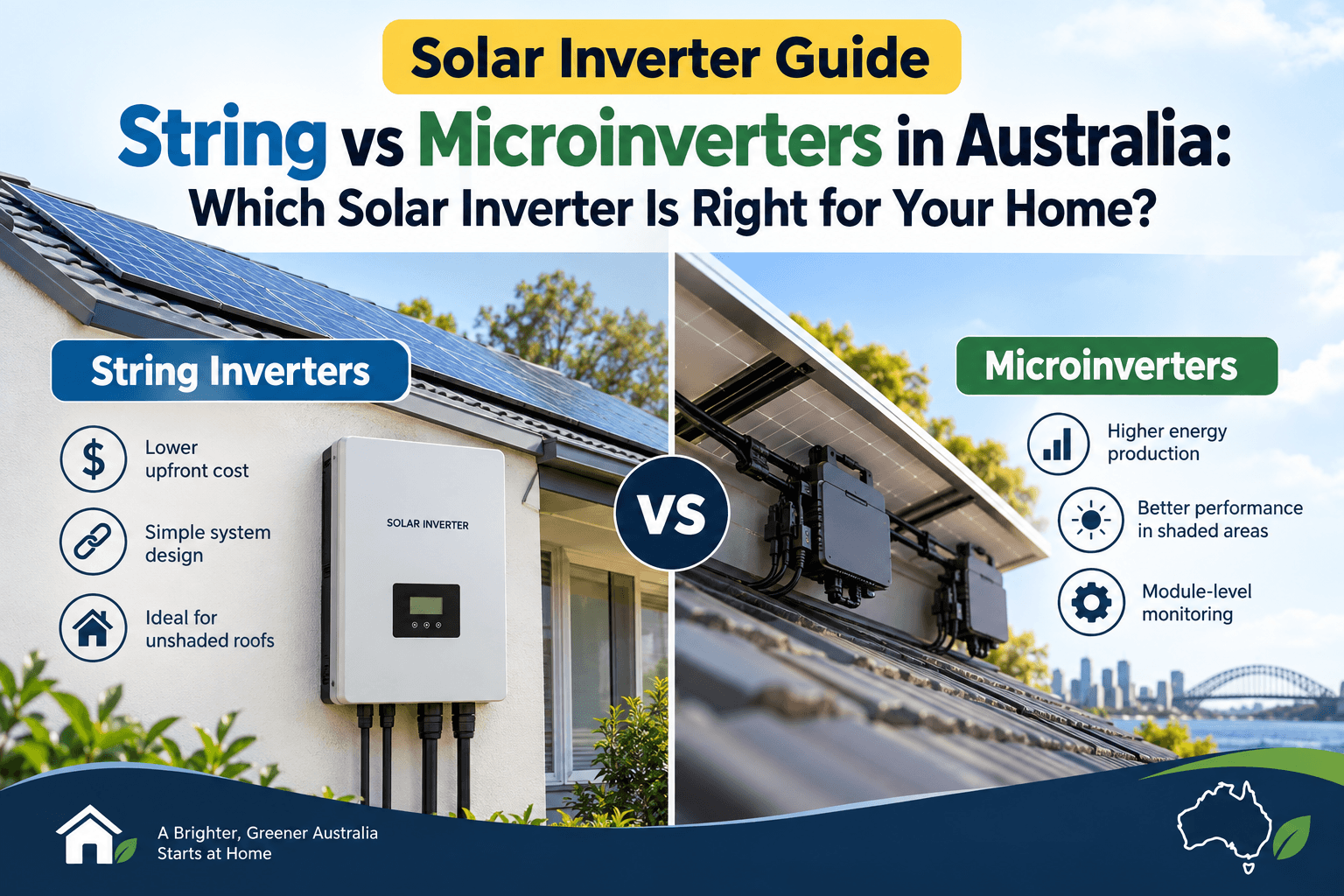
String vs Microinverters in Australia: Which Solar Inverter Is Right for Your Home?
Installing solar panels is an excellent way to generate renewable electricity at home, but the panels are only one part of a complete solar energy system. The inverter is equally important because it converts the direct current (DC) electricity produced by solar panels into alternating current (AC) electricity used by household appliances.
Australian homeowners can choose from several inverter technologies, including string inverters, microinverters and systems equipped with power optimisers. Understanding the differences can help you make a more informed decision when comparing solar installation quotes. What Does a Solar Inverter Do? Solar panels generate DC electricity when sunlight reaches their photovoltaic cells. Most household appliances operate using AC electricity, so an inverter converts the generated power into a usable form.
Depending on the system design, an inverter can also provide performance monitoring, fault notifications and compatibility with a home battery.
The right choice depends on your roof configuration, available budget, shading conditions and plans for future energy upgrades. The Australian Government's Solar Consumer Guide provides additional guidance on understanding solar technology and choosing a suitable system.
- String Inverters: A Common Choice for Australian Homes A string inverter connects a group of solar panels together and converts their combined DC output into AC electricity.
These inverters are widely used in residential solar installations because they are generally cost-effective and straightforward to maintain. Benefits of string inverters
- Generally lower upfront equipment costs.
- Established technology used in many residential systems.
- Centralised monitoring and maintenance.
- Suitable for many roofs with consistent sunlight exposure.
- Available in configurations compatible with selected battery systems. Potential limitations When panels are connected in a string, their electrical performance can influence the overall output of that string. Shade on particular panels may reduce performance, depending on the system configuration and inverter technology.
If your roof has several sections facing different directions, your installer may need to consider multiple strings, separate maximum power point trackers or additional equipment.
A string inverter can be an excellent choice for a home with relatively straightforward roof geometry and limited shading. 2. Microinverters: Panel-Level Energy Conversion Microinverters are installed at individual panels, allowing each panel to convert its electricity separately.
This arrangement can be useful when a property has different roof orientations or partial shading that affects some panels more than others. Benefits of microinverters
- Individual panel-level energy conversion.
- Detailed monitoring of panel performance on supported systems.
- Greater flexibility for certain complex roof layouts.
- Reduced dependence on the performance of neighbouring panels. Potential limitations Microinverter systems often cost more initially than conventional string inverter systems. They also involve equipment installed on the roof, which should be considered when evaluating product warranties, maintenance arrangements and long-term service requirements.
Microinverters are not automatically the best choice for every household. The additional cost should be weighed against the expected performance benefits for your particular roof. 3. What Are Solar Power Optimisers? Power optimisers are electronic devices fitted to individual panels and typically paired with a compatible string inverter.
They adjust the electrical output of individual panels to help manage differences in panel performance. This can be beneficial on roofs with multiple orientations or certain shading conditions.
Optimisers may also provide panel-level monitoring, depending on the equipment.
However, compatibility matters. The optimiser, inverter and any battery equipment must be designed to work together as a complete system. String Inverters vs Microinverters vs Optimisers
Feature String inverter Microinverters Power optimisers Energy conversion Central inverter At each panel Optimisers with central inverter Initial cost Generally lower Generally higher Varies Complex roof layouts Depends on design Often suitable Often suitable Panel-level monitoring Depends on system Common on supported systems Available on supported systems Battery compatibility Model dependent Model dependent Model dependent
These are general comparisons. Actual performance, warranty coverage and compatibility vary by manufacturer and model. The Australian Government also explains inverter options in its official inverter guide. 4. How Roof Shading Affects Your Decision Shading can come from neighbouring buildings, trees, chimneys, antennas and other rooftop structures.
If your roof receives consistent sunlight throughout the day, a conventional string inverter may provide a practical and economical solution.
If different roof sections receive sunlight at different times, or only a few panels experience shading, microinverters or optimisers may deserve closer consideration.
Ask your installer to assess shading across different seasons rather than relying on a single daytime inspection. 5. Think About Future Battery Installation Some Australian homeowners install solar panels first and consider adding a battery later.
If this is part of your plan, discuss battery compatibility before choosing an inverter. Some systems use hybrid inverters designed to work with batteries, while others may require additional equipment or a different configuration.
Also ask whether the proposed system can provide backup electricity during a grid outage. Standard grid-connected solar systems generally shut down during an outage unless they have specifically designed backup functionality. 6. Questions to Ask Before Choosing an Inverter Before signing a solar installation contract, ask your installer:
- Which inverter model is included in the quote?
- Is it listed as an approved product where required?
- How will the design manage shading and different roof orientations?
- Is the inverter compatible with my future battery plans?
- What are the product and installation warranties?
- How will I monitor system performance?
- What will happen if the inverter needs repair or replacement? Compare the complete system design rather than choosing solely on the inverter's advertised capacity or brand name. Conclusion Choosing between string inverters, microinverters and power optimisers depends on the individual property rather than a single solution being best for every home.
String inverters can offer a cost-effective option for straightforward roofs, while microinverters and optimisers may offer advantages for certain complex or partially shaded installations.
A professional roof assessment and a detailed, itemised quote can help you identify the most appropriate solution for your home.
Planning a solar installation? Contact our team to discuss your roof layout, inverter options and future energy requirements.
Written by Hujurat Solar Team
Get a free quote