
Solar Installation Guides•26 October 2026
Best Roof Direction for Solar Panels in Australia: Orientation, Tilt and Shading Explained
Your roof's direction, slope and exposure to sunlight can significantly influence how much electricity your solar panels generate. In Australia, north-facing roofs are often a strong starting point for solar design, but east- and west-facing panels can also suit many households. Learn how orientation, shading and seasonal sunlight affect your solar installation.
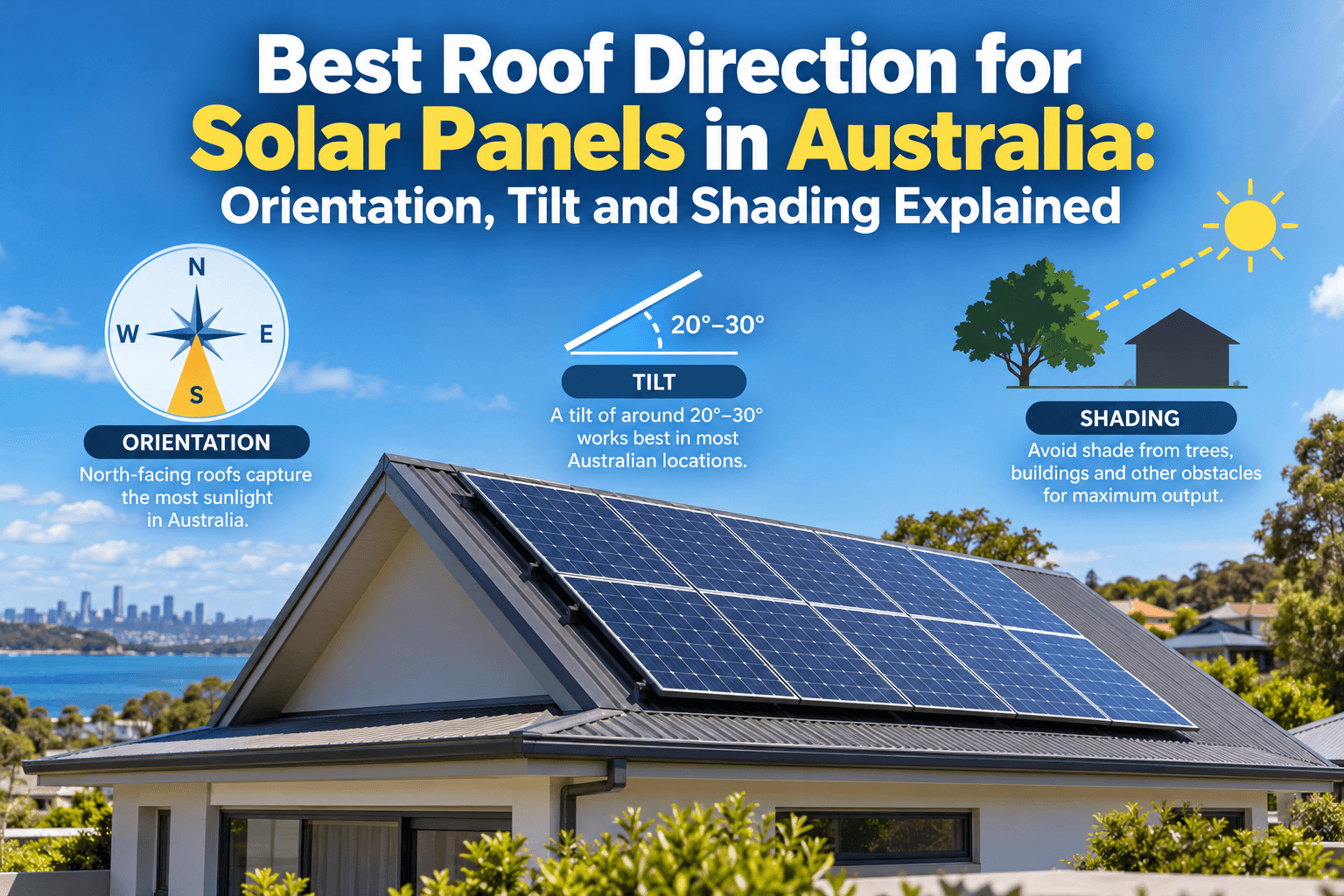
"Best Roof Direction for Solar Panels in Australia: Orientation, Tilt and Shading Explained"
When planning a rooftop solar installation, many homeowners focus on the number of panels and the system's total capacity. However, the position of those panels can also influence how much electricity the system generates throughout the day.
Australia's climate offers excellent opportunities for solar energy, but every property has different roof conditions. The best solar design takes account of roof direction, tilt, shading, local weather and the household's electricity consumption patterns.
Here is what Australian homeowners should understand before installing solar panels.
- Why Roof Direction Matters Solar panels generate electricity when sunlight reaches their photovoltaic cells. The direction a panel faces affects how directly it receives sunlight at different times of the day.
In Australia, which is in the Southern Hemisphere, north-facing panels often receive strong sunlight across the day and are frequently used in residential solar designs.
However, north-facing panels are not the only option. East- and west-facing panels can also provide valuable electricity, particularly when their generation patterns match a household's daily energy needs. 2. North-Facing Solar Panels North-facing panels are commonly considered a strong option for Australian homes because they can receive substantial sunlight throughout the day.
Potential benefits include:
- Strong daytime electricity generation.
- A useful generation profile for many household energy needs.
- The potential for good annual output when roof pitch and shading are suitable. The actual result depends on the property's location, roof slope, panel specifications and surrounding obstructions.
A north-facing roof is not automatically the most economical choice if it has significant shading or limited usable space. 3. East-Facing Solar Panels East-facing panels generally receive more direct sunlight in the morning.
This can be useful for households that use electricity early in the day for activities such as cooking breakfast, running appliances or preparing for work and school.
An east-facing installation may also help spread solar generation across more hours when combined with panels facing another direction.
The financial benefit depends on how much electricity the household uses while the panels are generating. 4. West-Facing Solar Panels West-facing panels tend to generate more electricity later in the day.
This may suit households where electricity consumption increases during the afternoon and early evening, including when residents return home, cook dinner or operate cooling systems.
West-facing panels may generate less electricity during some morning hours than a comparable north- or east-facing arrangement, but their later generation can still be valuable.
The important question is not simply how much electricity the system produces, but also when that electricity is available for use. 5. Can Solar Panels Work on a South-Facing Roof? South-facing roof sections generally receive less direct sunlight in Australia, particularly during winter and on steeper roofs.
Nevertheless, a south-facing roof does not automatically rule out solar.
A qualified installer can assess the roof's slope, local sunlight conditions, shading and available space to estimate expected output. In some circumstances, other roof sections may provide a better installation area.
Where roof space is limited, the installer may compare several possible panel layouts to identify a practical design. 6. Does Roof Tilt Affect Solar Performance? Yes. Panel tilt influences the angle at which sunlight reaches the panel surface.
On a pitched roof, panels are commonly installed parallel to the roof. This can be a straightforward installation approach and may reduce additional mounting costs.
On a flat or low-pitched roof, tilt frames may allow panels to be positioned at a different angle. However, these frames add cost and require spacing between rows to prevent one row from shading another.
The ideal tilt depends on the location, roof design, seasonal performance objectives and mounting constraints. There is no single tilt angle that is perfect for every Australian property. 7. How Shading Reduces Solar Generation Shading is one of the most important factors to consider before installing solar panels.
Common sources include:
- Trees and vegetation.
- Nearby houses and buildings.
- Chimneys and rooftop structures.
- Antennas and other equipment. The effect depends on how much of the array is shaded, how long the shading lasts and the electrical configuration of the system.
For example, a tree may cast a shadow over a roof during winter mornings even if the same roof receives full sunlight in summer.
An installer should evaluate shading throughout the year and consider whether panel placement, string configuration, microinverters or power optimisers could help.
For additional guidance, consult the Australian Government's solar system design guide. 8. Match Solar Generation to Your Household Routine The best roof layout should reflect your electricity usage, not just the maximum possible generation.
Consider the following examples:
- Morning energy use: East-facing panels may help produce more electricity earlier in the day.
- Consistent daytime consumption: North-facing panels may be a practical choice for many households.
- Afternoon energy use: West-facing panels may help supply electricity later in the day.
- Mixed daily consumption: A combination of roof orientations may provide a more distributed generation profile. These are general patterns, not guarantees. Your location, roof and energy consumption will determine the actual outcome.
- What If Your Roof Has Multiple Directions? Many Australian homes have several roof sections facing different directions.
Rather than treating this as a problem, an installer can assess whether panels should be distributed across multiple roof areas.
The final design may depend on inverter inputs, electrical string configuration, shading, available space and network connection requirements.
Ask for a site-specific design showing the proposed panel layout and the assumptions behind the expected annual generation. 10. How to Assess Your Roof Before Installation Before accepting a quote, check that your installer has considered:
- Roof direction and slope.
- Shade from nearby objects throughout the year.
- Available panel space.
- Roof condition and structural suitability.
- Likely generation at different times of day.
- Your current and anticipated electricity usage.
- Local grid connection and export requirements. You can also use the Australian Government-supported SunSPOT solar calculator to explore potential system configurations and estimated performance. Conclusion The best roof direction for solar panels in Australia depends on more than compass direction alone.
North-facing panels can offer strong daytime generation, while east- and west-facing panels may better match certain household routines. Tilt, shading and the property's location also play important roles.
A carefully designed installation can help you make better use of your available roof space and maximise the value of the electricity your system generates.
Written by Hujurat Solar Team
Get a free quote